The environmental sector in South Africa continues to offer structured, high-value entry pathways for recent graduates, particularly those holding qualifications in conservation science, geomatics, biodiversity protection, and water resource management. Among the most reputable conservation authorities in the country, CapeNature has officially opened applications for its 2026 Graduate Internship Program at CapeNature, creating two specialised, technically demanding placements for young professionals.
Unlike general administrative internships, these positions are designed as graduate technical roles that directly contribute to environmental monitoring, biodiversity data systems, catchment management, fire mapping, and compliance with the National Water Act. With the application deadline set for 22 April 2026, interested candidates are advised to prepare their documentation well in advance.
This article provides a comprehensive, authoritative overview of both internship streams, including eligibility criteria, key responsibilities, required competencies, and practical application advice. All information is current as of the publication date and reflects the official 2026 recruitment cycle.
Quick Overview of the 2026 Graduate Internship Program at CapeNature
| Programme Element | Details |
|---|---|
| Programme Name | CapeNature Graduate Internship Programme 2026 |
| Organisation | CapeNature (Western Cape conservation authority) |
| Contract Type | Fixed-term graduate internship |
| Locations | Jonkershoek Nature Reserve (Stellenbosch) & Cape Town Office |
| Internship Streams | Ecological Technician – Freshwater; GIS Technologist |
| Minimum Qualification | NQF Level 7 degree (Honours or MSc for Freshwater stream) |
| Citizenship | South African only |
| Employment Status | Must be currently unemployed |
| Driver’s Licence | Valid EB08 required for both streams |
| Application Method | Online via CapeNature careers portal |
| Closing Date | 22 April 2026 |
Why the 2026 Graduate Internship Program at CapeNature Matters for Conservation Careers
CapeNature is the statutory conservation authority responsible for biodiversity protection across the Western Cape, a region recognised globally for its unique fynbos biome and critical freshwater systems. The 2026 Graduate Internship Program at CapeNature is not a routine training scheme. It is a targeted effort to bring evidence-based scientific capability into operational conservation work.
Graduates who successfully enter this programme gain exposure to regulatory compliance, field monitoring, spatial data management, and high-level reporting processes. These are not simulated tasks. Interns contribute directly to the State of Conservation Report, the Annual Fire Report, the Annual Invasive Species Report, and the Catchment-to-Coast Strategy (2027). Such direct involvement in provincial environmental planning is rare at the entry level and significantly strengthens a graduate’s professional portfolio.
Related Opportunities 2026
• Funding Bursaries
• Youth Opportunities
• Internship Programme
• Learnership Programme
• Online Courses
Internship Stream 1: Ecological Technician – Freshwater (Jonkershoek Nature Reserve)
The first placement within the 2026 Graduate Internship Program at CapeNature is based at Jonkershoek Nature Reserve in Stellenbosch, operating under the Integrated Catchments Sub-Directorate. This role focuses on protecting freshwater ecosystems across provincial reserves, which is critical given that rivers and wetlands in South Africa face severe pressures from pollution, climate change, invasive species, and land-use change.
Core Responsibilities of the Freshwater Ecological Technician Intern
Successful candidates will engage in three major technical areas:
1. Water Use Licence Compliance Auditing
The intern will assist in determining whether CapeNature reserves already possess Water Use Licences (WULs), qualify under General Authorisations, or require new licence applications. This involves conducting desktop compliance audits, identifying licensing gaps, and assisting with Water Use Licence applications. Regulatory experience of this kind is highly valuable for future careers in environmental compliance and consulting.
2. Transformation of Freshwater Ecological Data
Raw field notes and spreadsheets require scientific validation and organisation. The intern will assist with structuring faunal datasets, transforming SASS scores into usable databases, organising wetland health assessments, and examining freshwater monitoring records. This ensures that CapeNature’s reporting remains evidence-based and defensible.
3. Supporting Freshwater Monitoring Fieldwork
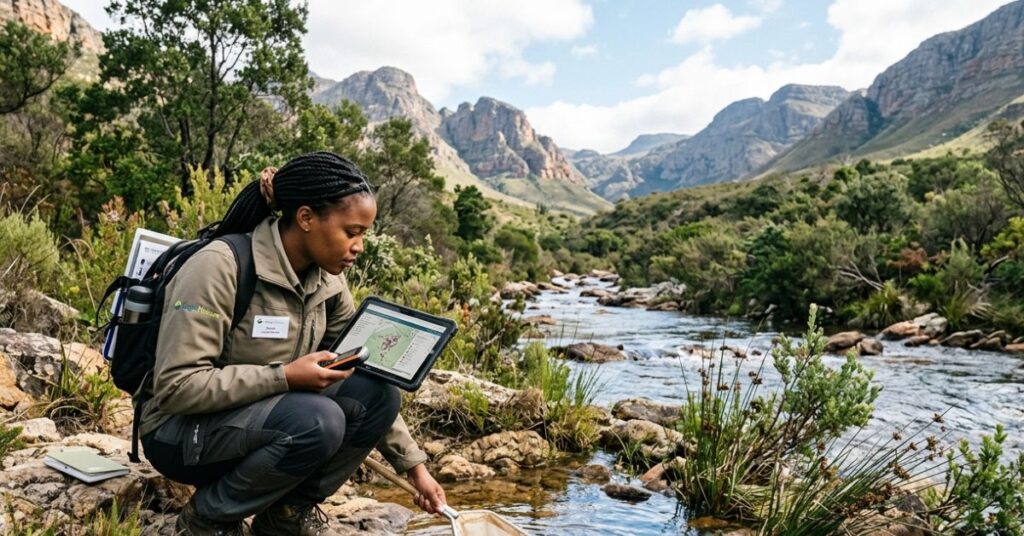
Direct participation in ecological monitoring programmes includes coordinating freshwater monitoring activities, assisting with river and wetland condition assessments, compiling technical site reports, and conducting literature reviews to support management strategies. This hands-on exposure builds strong scientific fieldwork credibility.
Eligibility Requirements for the Freshwater Ecological Technician Internship
Candidates must meet the following criteria:
- Citizenship and status: South African citizen, currently unemployed, with no criminal record.
- Qualification: BSc Honours or MSc in Freshwater Ecology, Water Science, Conservation Biology, Environmental Science, or a directly related field.
- Technical knowledge: Solid understanding of the National Water Act (Act 36 of 1998), practical knowledge of SASS5 biomonitoring, familiarity with wetland assessment protocols, and ability to identify aquatic fauna.
- Driver’s licence: Valid EB08 driver’s licence.
- Other requirements: Willingness to work in remote areas and ability to conduct field monitoring activities.
Internship Stream 2: GIS Technologist (Cape Town Office)
The second stream of the 2026 Graduate Internship Program at CapeNature is based in the Cape Town office, within the Biodiversity Capabilities Team. Geographic Information Systems (GIS) professionals are essential for mapping wildfire response, invasive species monitoring, biodiversity planning, catchment strategy modelling, and environmental reporting.
Core Responsibilities of the GIS Technologist Intern
1. Ensuring Spatial Dataset Compliance
The intern will assist in collecting spatial datasets, ensuring map accuracy, and confirming that GIS outputs adhere to organisational standard operating procedures (SOPs). Support may also be required for mapping during wildfire response operations.
2. Converting Historical Mapping Data
Much conservation mapping relies on legacy datasets that require modernisation. Tasks include standardising mapping datasets, assisting fire protection organisations, aligning municipal mapping, organising veld age and fire frequency datasets, and mapping invasive alien vegetation densities. These are highly transferable GIS skills.
3. Supporting Conservation Reporting Systems
The intern will contribute directly to major provincial conservation reports, including the State of Conservation Report, Annual Fire Report, Annual Invasive Species Report, and the Catchment-to-Coast Strategy (2027). These documents influence provincial environmental planning and policy.
Eligibility Requirements for the GIS Technologist Internship
- Citizenship and status: South African citizen, currently unemployed, with no criminal record.
- Qualification: Degree (NQF Level 7 or higher) in Geomatics, Environmental Management, Conservation Science, Ecological Science, Biological Science, or Zoology.
- Technical requirements: Working knowledge of ArcGIS, QGIS, GPS devices, cartography, and spatial analysis fundamentals.
- Driver’s licence: Valid EB08 driver’s licence.
- Additional requirement: Strong computer literacy.
Key Competencies CapeNature Expects from 2026 Graduate Internship Candidates
Both streams of the 2026 Graduate Internship Program at CapeNature require candidates to demonstrate:
- Strong organisational skills and attention to detail
- Ability to meet deadlines consistently
- Teamwork capability combined with independent work ethic
- Scientific problem-solving mindset
- Professional written and verbal communication skills
- Ecological reporting capability (Freshwater stream) or GIS technical documentation ability (GIS stream)
These competencies are not optional. They are critical for success in professional environmental science careers, particularly within provincial conservation authorities.
How to Apply for the 2026 Graduate Internship Program at CapeNature
Candidates must prepare the following documents before beginning an online application:
- Updated Curriculum Vitae (CV)
- Certified copy of South African ID
- Certified academic transcripts
- Certified copies of qualification certificates
- Copy of valid EB08 driver’s licence
- Any supporting technical certifications (e.g., SASS5 training certificate for Freshwater applicants)
Submission deadline: 22 April 2026. Late applications will not be considered.
Application links:
- APPLY FOR THE ECOLOGICAL TECHNICIAN – FRESHWATER INTERNSHIPS HERE
- APPLY FOR THE GIS TECHNOLOGIST INTERNSHIPS HERE
Note: Direct links are available on the official CapeNature careers portal. Candidates should verify URLs at the time of application.
Practical Advice for Applicants
Environmental internships in South Africa are highly competitive because they combine scientific rigor, conservation fieldwork, and policy exposure. To improve your chances of securing a place in the 2026 Graduate Internship Program at CapeNature, consider the following evidence-based recommendations:
Include the following on your CV and cover letter:
- Certificates of training in SASS5 biomonitoring (Freshwater stream)
- Demonstrated knowledge of GIS software, including any ArcGIS project experience (GIS stream)
- Wetland assessments or ecological fieldwork exposure
- GPS mapping experience
- Coursework or short courses on environmental legislation, particularly the National Water Act
- Undergraduate research projects, honours thesis topics, or biodiversity monitoring participation
CapeNature places a high value on evidence-based scientific capability. Generic applications are unlikely to succeed. Tailor your documentation to the specific technical requirements of each internship stream.
Frequently Asked Questions (FAQ)
Q1: Is the 2026 Graduate Internship Program at CapeNature paid?
Yes. CapeNature graduate internships typically include a stipend aligned with provincial internship frameworks. The exact stipend amount is confirmed during the appointment stage.
Q2: Can final-year students apply for the 2026 Graduate Internship Program at CapeNature?
No. Applicants must have already completed their qualifications before the application closing date. Final-year students who have not yet graduated are not eligible.
Q3: Is prior GIS knowledge necessary for the Freshwater Ecological Technician internship?
No. However, candidates for the freshwater stream must have completed SASS5 biomonitoring training. GIS skills are not a requirement for that role.
Q4: Is fieldwork mandatory for both internships?
Yes. Both streams involve visits to remote sites, ecological monitoring support (Freshwater), or conservation mapping activities (GIS). Candidates unwilling to perform fieldwork should not apply.
Q5: Can applicants from outside the Western Cape apply for the 2026 Graduate Internship Program at CapeNature?
Yes. However, selected candidates must be able to relocate to the specified locations (Jonkershoek Nature Reserve or Cape Town). Relocation costs are typically not covered.
Q6: Are postgraduate degrees required for both internships?
No. Only the Freshwater Ecological Technician role requires an Honours or MSc degree. The GIS Technologist internship requires a minimum NQF Level 7 degree (Bachelor’s degree), not necessarily a postgraduate qualification.
Q7: What is the closing date for applications?
The closing date is 22 April 2026. Applications submitted after this date will not be considered.
Q8: Where can I find more information about learnership programs and entry-level jobs in South Africa?
Additional opportunities, including financial literacy courses, entry-level job listings, and primary to secondary education resources, are available through platforms such as Edupstairs and the official CapeNature careers portal.
Final Thoughts on the 2026 Graduate Internship Program at CapeNature
For unemployed South African graduates holding qualifications in freshwater ecology, conservation biology, geomatics, or GIS, the 2026 Graduate Internship Program at CapeNature represents a structured, credible, and career-relevant entry point into the environmental sector. Unlike many generic internships, these placements offer direct exposure to regulatory compliance, scientific fieldwork, spatial data management, and provincial conservation reporting.
Given the closing date of 22 April 2026, prospective applicants should act promptly. Prepare your certified documents, tailor your CV to highlight technical competencies such as SASS5 training or ArcGIS experience, and submit your application through the official CapeNature careers portal before the deadline.
Conservation careers in South Africa require not only academic qualifications but also demonstrable field skills, regulatory knowledge, and professional discipline. The 2026 Graduate Internship Program at CapeNature is designed to build exactly those capabilities.
Disclaimer: This article is provided for informational purposes. Applicants are strongly advised to verify all details, including application links and stipend information, directly with CapeNature’s official careers portal before submitting any personal data or documents.

Thato Sabethwa is a passionate education advocate and digital content creator dedicated to helping young South Africans access valuable career and learning opportunities. With a strong belief in the power of skills development, Thato writes informative articles about learnerships, internships, bursaries, and job readiness. Through OnlineLearnership.co.za, Thato aims to guide students and job seekers toward the right opportunities that can shape their future. Her content focuses on practical advice, career tips, and reliable updates to empower readers to make informed decisions about their education and career paths.