If your NSFAS application was rejected, do not panic—and do not give up. Every year, thousands of deserving South African students successfully appeal their National Student Financial Aid Scheme (NSFAS) decisions and go on to receive full funding for their studies.
An NSFAS rejection does not automatically mean you are ineligible. In many cases, applications are declined due to missing documents, incorrect household income data, system verification errors, or changes in a student’s family circumstances that were not reflected at the time of application.
The NSFAS appeal process exists precisely to correct these issues.
This comprehensive 2026 guide explains how to appeal an NSFAS application rejection, who qualifies to appeal, which documents you need, common mistakes to avoid, and—most importantly—the NSFAS appeal closing date, so you do not miss your second chance.
Quick Overview: NSFAS Appeal Process 2026
Who can appeal?
Students whose NSFAS applications were rejected or provisionally declined.
How do you appeal?
Appeals are submitted online only via the official NSFAS student portal.
Key requirement for success
Strong, relevant supporting documents that directly address the reason for rejection.
NSFAS appeal closing date
Appeals usually close about 30 days after NSFAS application results are released, often between mid-January and late January for the new academic year.
Late appeals are not accepted under any circumstances.
Cost to appeal
Free. NSFAS does not charge any appeal fees.
What Is NSFAS and Why Appeals Matter
The National Student Financial Aid Scheme (NSFAS) is a South African government bursary programme designed to support students from poor and working-class households. NSFAS funding enables access to higher education at public universities and TVET colleges.
For qualifying students, NSFAS covers:
- Tuition fees
- Accredited accommodation or allowances
- Meals
- Transport (where applicable)
- Learning materials
Because NSFAS processes hundreds of thousands of applications each year, errors and incomplete assessments do occur. Appeals are an essential safeguard that allows students to correct mistakes or submit updated information.
Many funded students today were initially rejected.
Common Reasons NSFAS Applications Are Rejected
Understanding your rejection reason is the foundation of a successful appeal. Your NSFAS portal will clearly display why your application was declined.
The most common reasons include:
1. Household income exceeds the threshold
This often happens due to:
- Outdated income information
- Incorrect salary figures pulled from third-party databases
- Income linked to someone no longer supporting the household
2. Missing or invalid supporting documents
Examples include:
- Uncertified documents
- Blurry uploads
- Incomplete affidavits
3. Previous NSFAS funding history
Applicants who have already completed a funded qualification may be declined.
4. Academic eligibility not met
This can apply to returning students who did not meet progression requirements.
5. Identity or consent verification failure
Mismatched ID details or unsigned consent forms can trigger rejection.
6. Institution not funded by NSFAS
Only public universities and public TVET colleges qualify.
Your appeal must directly address the exact reason shown on your NSFAS dashboard. Generic appeals are rarely successful.
NSFAS Appeal Closing Date for 2026 (Critical Information)
NSFAS appeals do not remain open indefinitely.
Here is what students need to know:
- Appeals open shortly after NSFAS application results are released
- The appeal window typically lasts approximately 30 days
- In recent academic cycles, appeals have closed between mid-January and late January
- NSFAS does not grant extensions
Important reminder
If you miss the NSFAS appeal closing date:
- You cannot email your appeal
- You cannot submit documents manually
- You must wait until the next academic cycle
Always confirm the exact deadline displayed on your NSFAS portal, as dates may vary slightly each year.
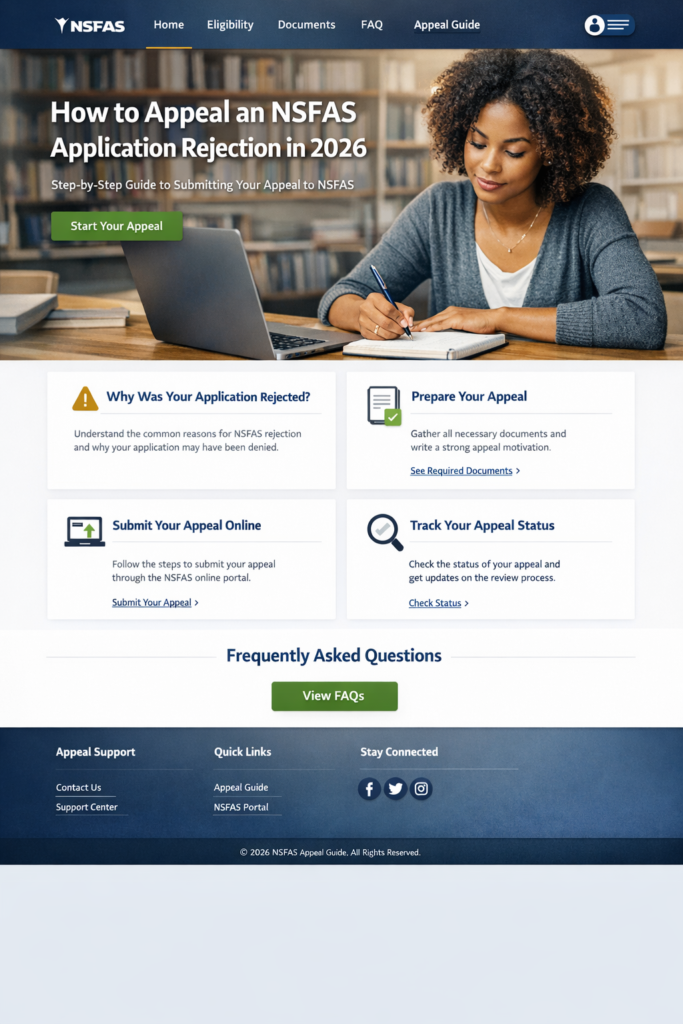
Step-by-Step: How to Appeal an NSFAS Application Rejection
Step 1: Log in to the NSFAS Student Portal
- Visit the official NSFAS website
- Click on MyNSFAS
- Log in using your South African ID number and password
Step 2: Check Your Application Status
- Select Track Funding Progress
- Confirm that your status shows Rejected or Provisionally Funded (Subject to Appeal)
Step 3: Click “Submit Appeal”
- If appeals are open, a Submit Appeal button will appear
- If the button is not visible, appeals may not yet be open or may already be closed
Step 4: Select the Correct Appeal Reason
- Choose the option that matches your displayed rejection reason
- Do not guess or select an unrelated reason
Step 5: Upload Strong Supporting Documents
This is the most important part of your appeal.
Only upload documents that prove your eligibility or correct the rejection issue.
Examples include:
- Updated proof of household income
- Retrenchment letters or UIF documentation
- Death certificate of a parent or guardian
- Sworn affidavits explaining family circumstances
- SASSA grant confirmation letters
- Corrected academic records
All documents must be:
- Clear and readable
- Correctly uploaded in the required sections
- Recently certified where certification is required
Step 6: Write a Clear Motivation (If Required)
If prompted:
- Be factual and honest
- Explain what changed or what was misunderstood
- Refer directly to the rejection reason
- Avoid emotional language or unrelated details
Step 7: Submit and Track Your Appeal
- Submit your appeal
- Save or screenshot the confirmation page
- Regularly log in to your NSFAS portal for updates
What Happens After You Submit an NSFAS Appeal?
After submission, NSFAS begins a verification process that may include:
- Reviewing uploaded documents
- Verifying income data with SARS
- Confirming identity details with Home Affairs
- Checking academic registration with institutions
Appeal outcomes are released in phases, not all at once.
Possible outcomes
- Appeal Approved – NSFAS funding is awarded
- Appeal Unsuccessful – The original decision stands
NSFAS does not allow second appeals after a final decision.
Common Mistakes That Cause NSFAS Appeals to Fail
Many appeals are rejected due to avoidable errors. Avoid the following:
- Uploading the same documents that caused the initial rejection
- Submitting uncertified or unreadable files
- Ignoring the stated rejection reason
- Waiting until the final day to appeal
- Using generic affidavits without explanation
- Providing false or exaggerated information
Accuracy and relevance matter more than volume.
Expert Advice for Students Appealing NSFAS Decisions
An NSFAS rejection is not a judgment of your intelligence or potential. In most cases, it is an administrative or documentation issue.
Students who succeed with appeals typically:
- Act early
- Submit clear, updated evidence
- Follow instructions exactly
- Monitor their portal consistently
Treat the appeal process as seriously as the original application.
Career and Education Opportunities After NSFAS Approval
Successful NSFAS funding can unlock long-term opportunities, including:
- Completion of a recognised qualification
- Access to internships and learnerships
- Eligibility for graduate programmes
- Improved employability and income prospects
Education funding is not just financial assistance—it is a career investment.
Frequently Asked Questions (FAQs)
Can I appeal if my household income is above the NSFAS threshold?
Only if there has been a material change, such as retrenchment, death, or loss of income. Documentary proof is mandatory.
Can I submit my NSFAS appeal via email?
No. NSFAS appeals are submitted online only through the official student portal.
How long does NSFAS take to respond to appeals?
Response times vary. Some outcomes are released within weeks, while others are finalised closer to registration periods.
Can both university and TVET students appeal?
Yes. Both public university and public TVET college students may appeal, provided their institutions are NSFAS-funded.
Is there a fee to submit an NSFAS appeal?
No. The NSFAS appeal process is completely free.
Final Thoughts
If your NSFAS application was rejected, your journey is not over. The appeal process exists to ensure fairness and accuracy—and many students secure funding on appeal every year.
Log in early, submit strong evidence, respect the deadline, and follow the process carefully. A successful appeal can change not only your academic future, but your entire career path.

Thato Sabethwa is a passionate education advocate and digital content creator dedicated to helping young South Africans access valuable career and learning opportunities. With a strong belief in the power of skills development, Thato writes informative articles about learnerships, internships, bursaries, and job readiness. Through OnlineLearnership.co.za, Thato aims to guide students and job seekers toward the right opportunities that can shape their future. Her content focuses on practical advice, career tips, and reliable updates to empower readers to make informed decisions about their education and career paths.